The science of smart-packing — fitting 36 snacks in a 5 kg box
Every shipping box has a fixed weight cap. The real game is how efficiently you fill it. A look under the hood at DelicaGlobal's box-fill UX.
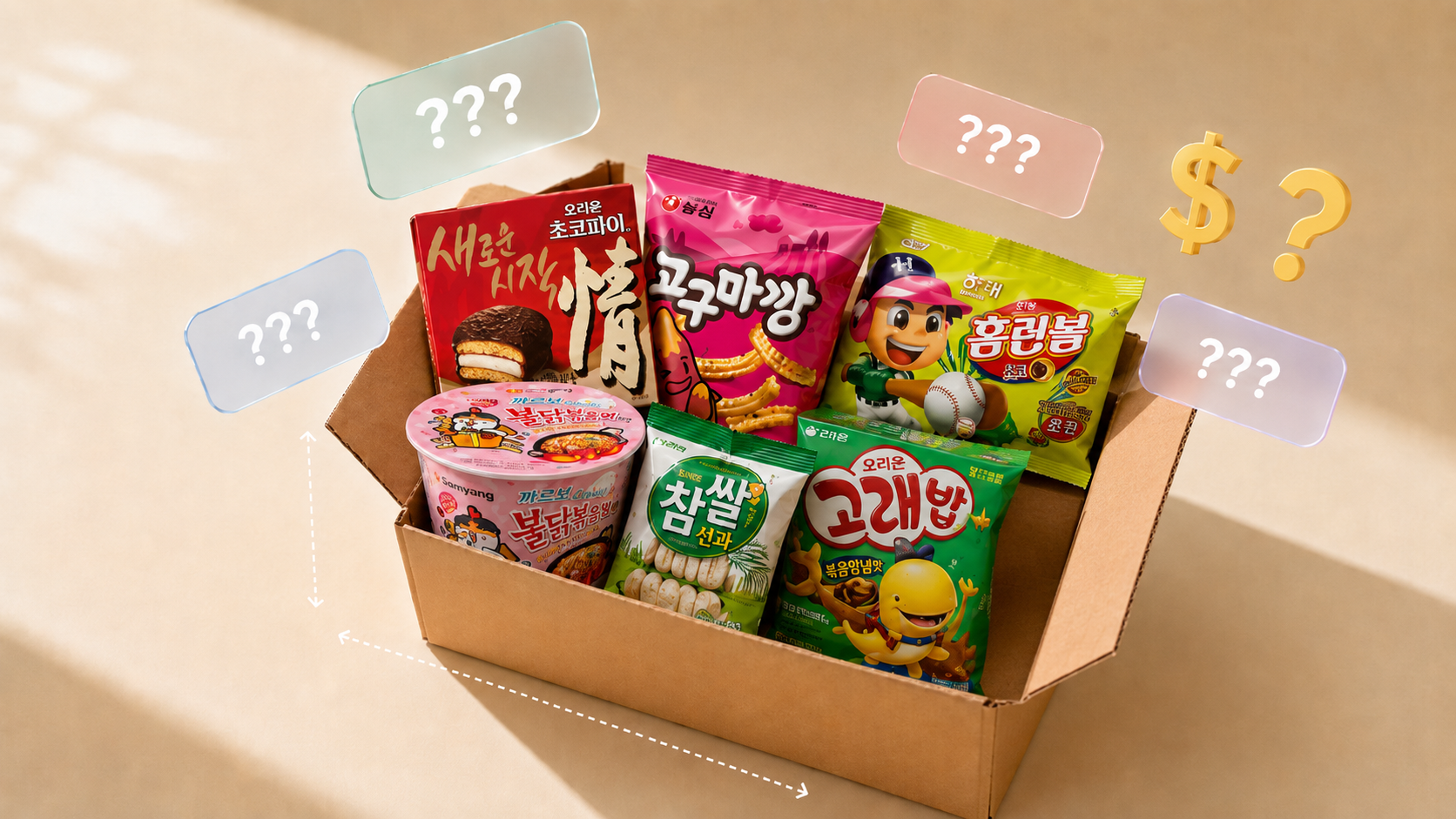
Shipping boxes from Korea to Singapore come in fixed tiers — 5 kg, 10 kg, 20 kg. That's how freight gets priced, and that's what determines the cost of a single box.
But most K-snack cross-border services ship those boxes half-empty. Because a human packs them by hand. The "wasted space" is wasted money, and yet — nobody measures it, and nobody shows it to the customer.
DelicaGlobal reframed this as a UX problem, not a logistics one.
1. Volume + weight data on every product
We measure and store the exact volume and weight of every product we carry (currently 800+). Not just bounding-box dimensions — actual measured volume for irregular packages, stackability flags, and whether the package is fragile.
That dataset is the foundation of our box-fill algorithm.
2. Real-time fill meter
Every time you add an item to your box, a gauge at the top of the screen fills:
- 30% → "Room for more"
- 60% → "A few more drops the per-snack price"
- 92%+ → "Optimal — place your order."
At that point, the price per snack drops below what you'd pay at the convenience store next to the factory in Seoul. That's our 10× edge.
3. The Tetris algorithm
The algorithm that fills the box isn't computer vision — it's our volume dataset combined with a 3D bin-packing algorithm. No matter what order a customer picks items in, the backend instantly recomputes the optimal layout.
The most interesting discovery: when customers pack the box themselves, they buy more. Average order value is 2.3× higher than competing K-snack stores. Because it feels like a game.
The takeaway
If the box matters most, optimize the box. Cross-border K-snack commerce isn't really about curation — it's about space efficiency. We're the first company to hand that efficiency back to the customer.